

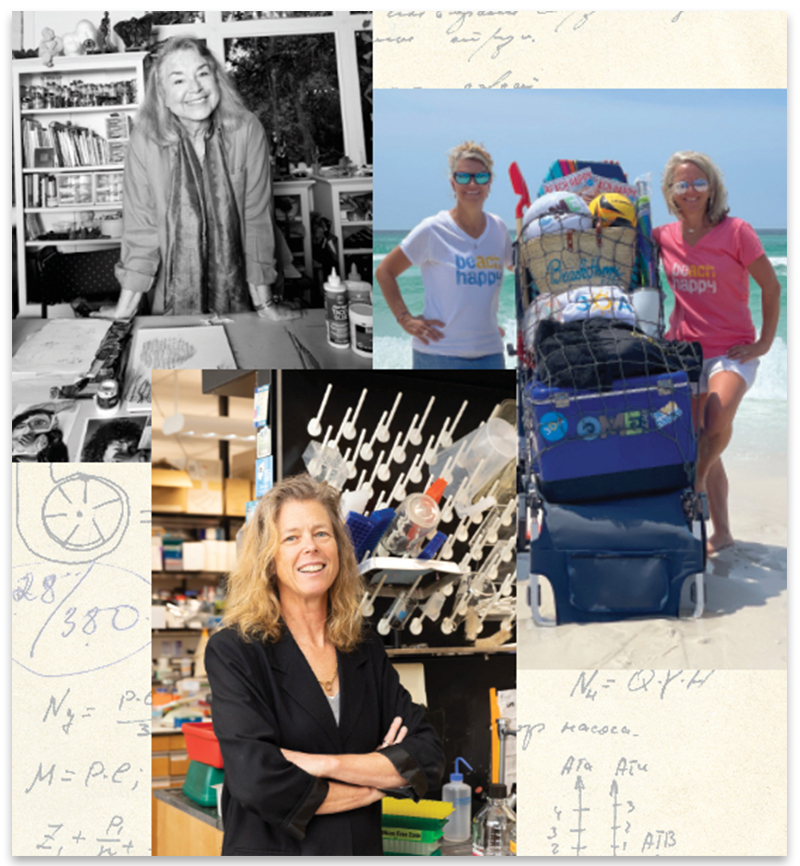
(Clockwise from top left) Jogbra inventor Lisa Lindahl, OME Gear’s Jules Weldon and Stacey Pierce, and MitoChem Therapeutics co-founder Bärbel Rohrer
As she sits outside Normandy Farms near her home in West Ashley, Lisa Lindahl glances at a young woman entering the bakery in a pair of leggings and a sports bra. It’s a ubiquitous sight today, thanks to the odds-defying “little mail-order business on the side” that Lindahl started in grad school in 1977. Said business? Inventing and selling the Jogbra, the world’s first sports bra.
She’s in good company. “Charleston is an amazing place for an inventor,” says Stanfield Gray, an innovator in his own right who founded the city’s DIG SOUTH technology summit. There’s a diverse pool of entrepreneurs, ranging from toy makers and software developers to biscuit bakers and oyster knife manufacturers. There’s also a wealth of organizations dedicated to helping get ideas off the ground (see the “Helping Hands” sidebar, page 91). “Charleston punches above its weight relative to the resources we have and size of the population,” Gray adds.
While there’s still a divide between the numbers of male and female inventors, “It’s been incredible to watch the growth in both MUSC’s and Charleston’s innovation ecosystems over the last decade,” notes Jesse Goodwin, chief innovation officer at the Medical University of South Carolina (MUSC) and co-lead of a new initiative, STEM-CREW (Coaching and Resources for Entrepreneurial Women), to provide support for female entrepreneurs.
“We are a small percentage, and Elizabeth Holmes didn’t help,” says Bärbel Rohrer, an MUSC neuroscientist who invented eye drops to prevent blindness, referring to the disgraced founder and CEO of the fraudulent blood-testing company, Theranos. “You do still face an uphill battle as a woman, but I’ve never let that stop me. I hold my own.”
Women comprise just 18 percent of patent holders, and the majority share those patents with men. “The percentages are pretty staggering,” says Jules Weldon, who along with her wife, Stacey Pierce, is the co-founder and CEO of OME Gear and inventor of The Wanderr beach cart/chair. “Only 2.7 percent of venture capital funding goes to women—2.7 percent. That’s it.”
But these local innovators echo Lindahl’s sentiment: “No matter what your adversity is or what the perceived obstacles are, they don’t have to stop you.” Despite the daunting odds, women like Weldon, Pierce, Lindahl, and Rohrer have thrived, joining the small, elite group of female patent holders, inventors, and entrepreneurs. These are their stories.
Support System - Lisa Lindahl
The Jogbra story starts in 1977 with a few extra pounds. Lisa Lindahl was an aspiring artist, taking classes at the University of Vermont (UVM), working as a secretary, and floundering in a lackluster marriage. The 28-year-old had never embraced fitness since her grade school gym classes, and her sedentary lifestyle led to her first experience with weight gain. A friend told her to run a mile and a quarter three times a week to lose the weight, and she got hooked. “This was the beginning of the fitness revolution, and jogging was the thing,” she says. >>READ MORE OF THE JOGBRA STORY HERE
Shifting Gears - Jules Weldon & Stacey Pierce
Having raised six children, Paul and Jerie Weldon well understood the challenge of hauling gear. Twenty-four years ago, while watching a mother of three wrangle her stuff after a day at the beach, they thought there must be a better way. “She was miserable,” explains their daughter Jules. “My parents went up and napkin-sketched out this lounger. If you flipped it up, it became like a dolly.” >>READ MORE ABOUT THE OME GEAR STORY HERE
Coming Into Focus - Bärbel Rohrer
Bärbel Rohrer has had a central focus throughout her career: how the retina works, how it degenerates, and what can be done to prevent degeneration. The MUSC neuroscientist, professor, SmartState Endowed Chair in ophthalmology, and MitoChem Therapeutics co-founder and chief scientific officer has spent the last decade exploring mitochondrial metabolism—essentially energy production in cells. “Pretty much every retinal disease I’ve ever looked at, whether it’s retinitis pigmentosa or glaucoma or dry age-related macular degeneration, the mitochondrial metabolism goes down,” Rohrer explains. >>READ MORE ABOUT MITOCHEM'S WORK TO PREVENT RETINAL DISEASE
HELPING HANDS - 15 resources for local start-ups, entrepreneurs, & inventors
■ 1 Million Cups Charleston (opens in a new tab)
■ Charleston Digital Corridor (opens in a new tab)
■ Charleston Metro Chamber of Commerce (opens in a new tab)
■ Charleston Regional Development Alliance (opens in a new tab)
■ Charleston Tech Center (opens in a new tab)
■ Charleston Women in Tech (opens in a new tab)
■ DIG SOUTH (opens in a new tab)
■ EO Charleston (opens in a new tab)
■ The Harbor Entrepreneur Center (opens in a new tab)
■ Local Works (opens in a new tab)
■ MUSC Innovation Center (opens in a new tab)
■ South Carolina Economic Developers Association (opens in a new tab)
■ South Carolina Research Authority (opens in a new tab)
■ Startup Grind Charleston (opens in a new tab)
■ Zucker Institute for Applied Neurosciences (opens in a new tab)
Making History - Local innovators from the 19th century to today >>LEARN MORE HERE
In this story
Support System - Lisa LindahlShifting Gears - Jules Weldon & Stacey PierceComing Into Focus - Bärbel RohrerMaking History: Local innovators from the 19th century to todayResources
Photographs by Mira Adwell and Aleece Sophia and courtesy of Lisa Lindahl, Smithsonian National Museum of American History, OME Gear, & MitoChem Therapeutics