

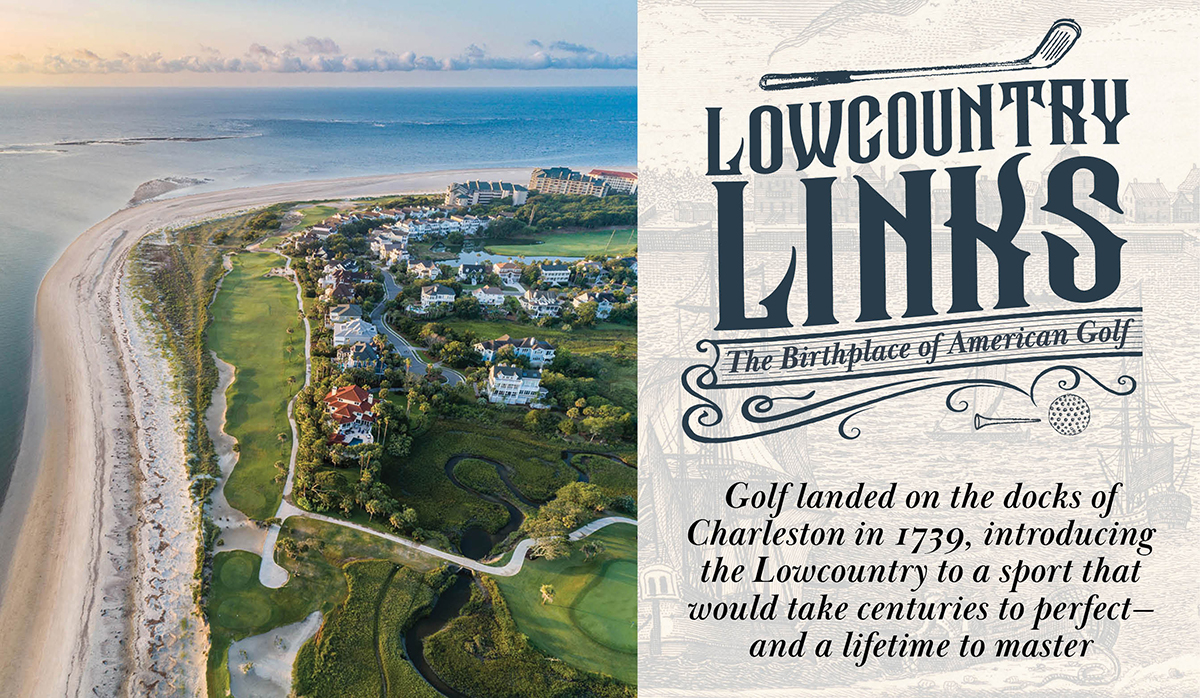
On June 29, 1739, the ship Carolina, inbound from the Port of Leith near Edinburgh, Scotland, pulled alongside a Charleston pier as dockworkers waited to unload its goods. Its cargo included a parcel addressed to prominent local merchant and Scottish emigrant William Wallace. It carried a bill of lading for one pound, 18 shillings and most unusual contents: a set of clubs called “woods” and a box of feather-stuffed leather balls—the basic equipment for a sport that had been popular in Scotland since the 14th century was making an inauspicious arrival in the New World. It was called golf.
At that time in Charleston, horse racing remained the favored pastime of the planter class, but almost everyone among the hard-working mercantile class of emigrant Scots—brewers, bankers, and booksellers alike—knew the game of golf from their homeland. (Leith Links, in fact, was one of Scotland’s earliest courses, a five-holer set in the middle of a race track dating back to 1672.) These men needed a break from the tedium of their labors and a breath of fresh air from their daily routines, and golf, then as today, afforded it. As the 18th-century novelist Tobias Smollett wrote of the course at Leith, “Such uninterrupted exercise, cooperating with the keen air from the sea, must, without all doubt, keep the appetite always on edge, and steel the constitution against all the common attacks of distemper.” He could just as easily have been describing Charleston.
As word spread back to the homeland that there was plenty of land, unobstructed views, and growing interest in America, more shipments arrived, perhaps sent in the hopes of new business prospects. Ninety-six clubs and 432 balls were delivered by the Magdalen in 1743 for the merchant David Deas—a mother lode. Andrew Johnston, who had several business interests, brought clubs and balls back with him from a trip home to Scotland in 1759. The sport grew.
First in Golf: Harleston Green
By 1786, Scottish merchants had organized themselves into the first golf club in America: the South Carolina Golf Club of Charleston. Although a club later emerged in Savannah around 1794, both predate what is generally reckoned as the oldest continuously operating club in the United States—the Saint Andrews Golf Club in Yonkers, New York, founded in 1888.
Within a decade, a clubhouse was built on a patch of land between Bull and Pitt streets, just south of where the College of Charleston’s Addlestone Library is today. Members would meet nearby for food and drink at William’s Coffee House and then make their way to the “course” (a misnomer, as it was merely an overgrown pasture). The land was known then, as it is today, as Harleston Green. Here, sometime in the late 18th century, the first game of golf was played in America. Participants had to pay to play—that is, money was needed to maintain the grounds—and so the fees they forked over for the game came to be known as “green fees.”
What was known originally as “The Ancyent & Healthfulle Exercyse of the Golff” bore only a faint resemblance to the game that is played today. There were no set number of holes, to begin with, and the “holes” were just that—crudely dug excavations with no putting surface surrounding them. There weren’t even any pins or flags to mark the target. Instead, a finder or “forecaddie,” usually a young boy, was sent ahead to find the hole and stand near it, often holding a gull’s feather as a signpost. The forecaddie also cleared the fairway of animals and other people on the land—perhaps strollers, courters, and others enjoying fine weather—by yelling “Fore!”—as in, “you have been forewarned!”
Caddies carried the clubs in a bundle (“pencil bags,” named for their shape, were a late 19th-century invention), though the so-called “play club” was the most used. The shaft was made of hickory and the head of hardwoods. Other clubs, called “spoons,” were fabricated with facings that had various degrees of loft, just as today. These, too, were wood, however. The only metal club to be used was one to retrieve errant balls from out of bounds.
The balls, called “featheries,” were made of three or four pieces of untanned bull’s hide stitched together, leaving a small opening into which wet goose feathers that had been boiled or steamed were stuffed. As the feathers dried, they expanded, creating a hard, compact ball. Though costly and prone to damage, a well-made feathery could travel up to 150 yards in the hands of a skilled player—remarkably lively, though no match for today’s high-tech counterparts.
The Country Club
By the late 19th century, golf was showing signs that it would become the wildly popular sport it is today. An 1895 editorial in The Evening Post suggested that a permanent course be established in the area. The Chicora Golf Club soon followed and would later be called the Country Club of Charleston.
The original course, a nine-holer, opened in the fall of 1900 at Chicora Park, along the banks of the Cooper River. Within a year, however, the property was sold to the US Navy, which wanted to establish a base there. In July 1901, the founders moved the course to Belvidere Plantation, near Magnolia Cemetery, where a new nine-hole course was laid out.
The Country Club flourished, the site not just hosting golf tournaments but also lavish dinners, galas, and debutante balls. As membership grew, the club realized that it would need larger grounds for its main activity, so, in 1922, it acquired its present location on James Island, 900 acres from the McLeod and Frampton families (much of it marsh) on the banks of the Ashley River. The planning for the new club was conducted by the Olmsted Brothers landscape firm, the son and son-in-law of the late Frederick Law Olmsted, the landscape architect responsible for Central Park and other historic green spaces. The Olmsteds recommended the legendary Seth Raynor to lay out the course, which he did between 1923 and 1925.
A Princeton-educated engineer, Raynor trained under Charles Blair Macdonald, who had taught his pupil how to fit the concepts of the best holes of courses around the world into the existing terrain he was designing—hole templates, if you will. For example, on the par-three Hole 11, based on the 15th hole at North Berwick in East Lothian, Scotland, the green sits atop an unexpected plateau, protected on both sides by steep bunkers. The redoubtable pro Sam Snead, who was thought by many to have the perfect swing, took an unlucky 13 strokes on that hole. “Your greens are beautiful,” he reportedly quipped, “but what you need for that 11th hole is about five sticks of dynamite.”
Raynor and the Olmsted firm also collaborated on the course at Yeamans Hall, in Hanahan, in those same years. The 1,000-plus acre parcel was originally a working plantation granted to Sir John Yeamans by the Lords Proprietors in the late 17th century. Unlike the homegrown Country Club, the Yeamans Hall Golf Club was the effort of 10 prominent New Yorkers who had visited the area and thought it perfect for “an admirable winter resort.” The club was officially organized in Manhattan on April 20, 1925, and opened in February 1926.
Country Club Players
Throughout its history, the Country Club of Charleston has hosted many important tournaments—27 state championships and the 2019 US Women’s Open among them—and served as the cradle of many champions. Its assistant and then head pro from 1925 to 1934, Henry Picard (“Pic” to his friends) rose to national prominence, going on to win the 1938 Masters and the 1939 PGA Championship. He famously advised a struggling Ben Hogan to weaken his grip, helping the young pro overcome a persistent hook. In gratitude, Hogan later dedicated his famous book, Power Golf, to Picard, “an outstanding player, an outstanding teacher, and an outstanding man.”
After a long career as both a competitor and a teaching professional, Picard returned to Charleston in the early 1970s, where he remained a fixture of the local golfing community until his death in 1997. During those years, he mentored many rising stars, including future LPGA Hall of Famer Beth Daniel, a Charleston native.
Equally renowned are the amateurs who’ve played there, especially the Fords, the first family of amateur golf in the Lowcountry. The dynasty began with its scion, Frank Ford Sr., who lived to the age of 100; was carried on by his son, Tommy; and is still going today, a successive four generations of players who have racked up more than 100 amateur championships.
The Muni
Another legendary local course and home to numerous men’s, women’s, juniors’, and seniors’ tournaments, the City of Charleston Municipal Golf Course was created in 1929, the same year the South Carolina Golf Association was founded. Known affectionately as “The Muni,” it lies on the scenic savannahs of the Stono River, just off Maybank Highway. Its 120 acres were donated to the city for use as a public course in 1927 by C. Bissell Jenkins, a local businessman who developed the neighboring community, Riverland Terrace.
The Muni recently underwent a significant renovation and reopened in 2021. Although redesigned and made more challenging, it still retains its unassuming, neighborly feel, unlike some higher-end courses where the green fees can reach into the hundreds of dollars. Here, one can devote oneself to what the poet William Wordsworth oxymoronically, but accurately, described as “strenuous idleness.” (In today’s parlance, a good walk spoiled.) Plus, even if your scorecard for 18 holes reads like you wish it were for nine, there’s always the refuge of the Fox Den Bar & Grill—an unpretentious café and time capsule of the 1950s, mercifully untouched by the recent upgrades.
Playing Through
After World War II, the sport of golf expanded like no one could have foreseen, as American families moved away from cities looking for leisure and recreation. South Carolina responded to this boom, and today, there are 350-plus courses in the state, more than 20 of them in the Lowcountry alone. Seven can be found on Kiawah Island, where the Pete and Alice Dye-designed Ocean Course has become a mecca for golfers from around the world. Here, the “War by the Shore” was waged during the 1991 Ryder Cup, with the US team winning by the narrowest of margins (14½ to 13½ points). The windswept course—iconic and unforgiving—has witnessed many epic moments in the history of this most unusual game.
Perhaps the most instructive was the win there by a 50-year-old Phil Mickelson at the 2021 PGA, when the veteran golfer proved two things: First, golf may be the world’s most unpredictable game. And second, its wonderful uncertainty must be what keeps players and fans coming back.